Connecticut’s New Housing Rule Opens Commercial Land to Small Apartment Buildings
Since Jul. 1st, buildings with two to nine homes on commercial or mixed-use lots get a streamlined review. Here is what the rule requires and what remains up to towns.
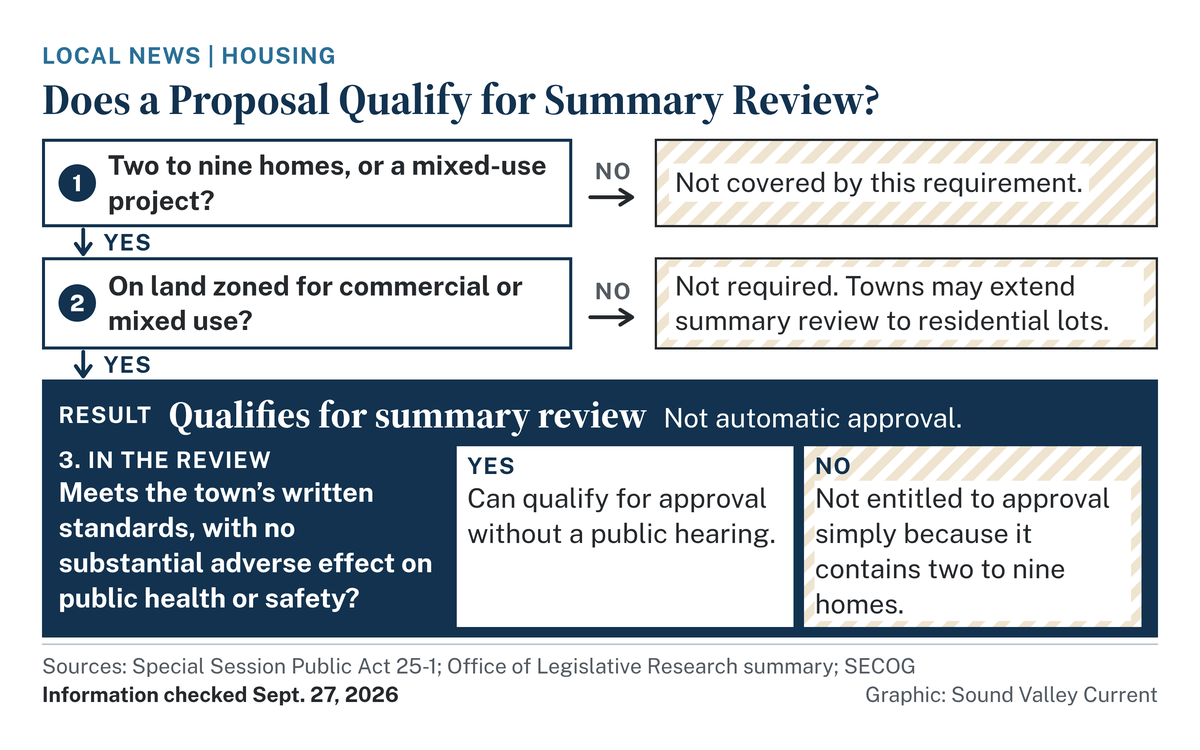
A proposal for six apartments above a storefront on a commercial strip can now qualify for approval without a public hearing. Since Jul 1st, Connecticut law has required that result when the project meets the town’s written zoning rules and does not create a substantial adverse effect on public health or safety.
The requirement comes from Special Session Public Act 25-1. It directs municipalities to allow “transit community middle housing,” meaning buildings with two to nine homes, and mixed-use projects on land zoned for commercial or mixed use. Qualifying projects receive what the law calls summary review.
What Does Summary Review Change?
Summary review shifts the decision from discretion to written rules. A board can still enforce zoning standards and address a specific health or safety harm that conditions cannot fix, but a qualifying project does not have to win a discretionary public hearing. Site plan review remains available.
Does This Mean Anything Can Be Built?
No. A project still must meet the dimensional, building, fire, environmental, utility and access rules that apply to its site. A proposal that fails those standards, or creates a substantial adverse effect on public health or safety, is not entitled to approval simply because it contains two to nine homes.
Where Does the Rule Apply?
The requirement applies to lots already zoned for commercial or mixed use. It does not rezone residential neighborhoods, although towns may choose to extend summary review to residential lots.
What About Parking?
For residential developments with 16 or fewer units, a town generally may not reject an application solely because it falls short of an off-street parking requirement. Rejection on that ground is allowed only if the town finds that the lack of parking would have a specific adverse impact on public health and safety that cannot be mitigated through approval conditions that do not substantially harm the project’s viability.
For projects with 17 or more units, towns may apply parking minimums, and they must allow a developer to submit a parking-needs assessment. Towns may also establish up to two conservation and traffic-mitigation districts, within the act’s size limits, where different rules may apply.
Developers may still provide parking. Towns may still review circulation and safe access.
Is This the Transit-Oriented Program?
That is an optional program towns may join for related incentives, not the middle-housing provision already in effect.
The law sets later deadlines for regional housing-needs assessments and local housing-growth plans in 2027 and 2028. Those deadlines do not delay the zoning changes that began in July.
What Does It Mean in the Valley?
Sound Valley Current has not identified a Valley application filed under the rule. Until one arrives, the local effect is procedural: qualifying proposals on commercial or mixed-use land must be judged under the new summary-review standard.